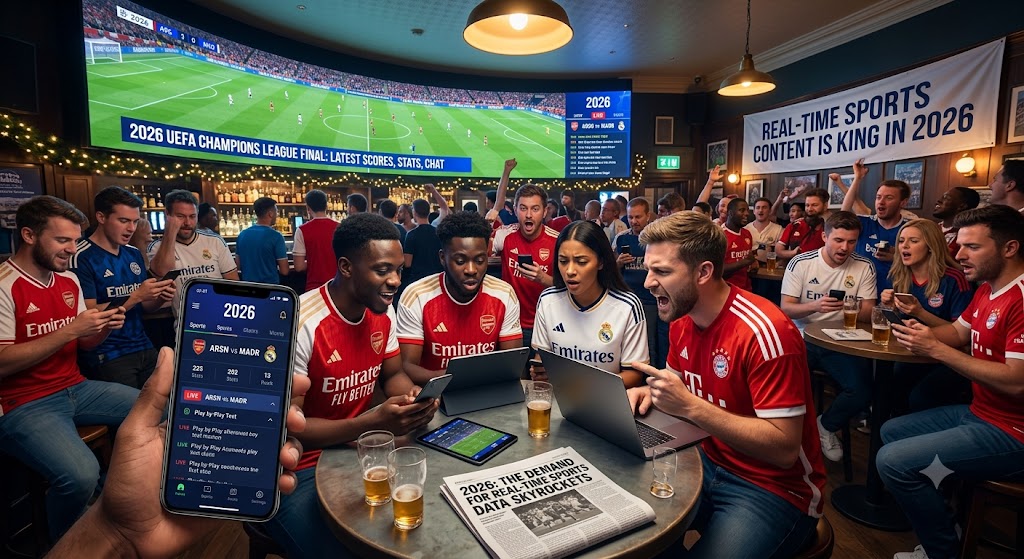
Football Fans Continue Driving Demand for Real-Time Sports Content in 2026
Published on: Jun 17, 2026
The global appetite for immediate sports updates has reached an unprecedented peak, completely altering the foundation of modern media consumption. Football enthusiasts are no longer content with waiting for scheduled television highlights or refreshing static news feeds after the final whistle has blown. The contemporary sports fan operates in a continuous, fast-paced digital environment where live data, tactical updates, and instant video replays are expected at the tap of a touchscreen. This relentless push for instantaneous access is forcing media companies, tech firms, and content developers to completely reinvent how athletic data is processed and distributed to a demanding global audience.
Shifting Viewing Habits and the Resiliency of Aggregators
As official media rights become hyper-fragmented across an increasingly complicated and expensive web of regional streaming apps, fans face significant platform fatigue. This high level of market division has fundamentally altered consumer navigation, causing a substantial portion of the audience to seek out unified community directories like Footybite to find immediate score tickers, team updates, and centralized match links. Despite heightened corporate enforcement, real-time domain restrictions, and sophisticated anti-piracy protocols implemented by international broadcasting coalitions, the persistent reliance on these alternative hubs underscores a wider structural market issue. When official channels partition access behind complex walls, informal networks adapt seamlessly to meet the raw public demand for immediate football information.
Technological Infrastructure Cracking Under Mass Consumer Strain
The structural weight of this immense digital demand is severely testing web distribution pipelines as millions of concurrent users stream media simultaneously. Major network operators and primary rights holders are pouring vast capital resources into decentralized content delivery networks (CDNs) optimized to manage massive traffic spikes with zero latency. Modern sports audiences maintain a remarkably low tolerance for video buffering or frame drops, especially during high-stakes international tournament windows where a minor five-second system delay can result in second-screen social media platforms spoiling a critical game-winning goal. This engineering pressure is accelerating the development of robust, real-time data integration, setting a new global baseline for high-capacity media streaming across the entire entertainment sector.
Historic Showdowns Trigger Massive Global Traffic Spikes
The sheer scale of contemporary digital sports engagement is perfectly illustrated by the historic matches unfolding across the international arena right now. At the highly anticipated 2026 FIFA World Cup across North America, defending champions Argentina officially opened their account with a definitive 3-0 victory over Algeria, electrified by a magical, career-defining hat-trick from Lionel Messi in his historic sixth tournament appearance. On the very same day, French phenomenon Kylian Mbappé sparked an impressive performance with a brilliant brace to secure France's 3-1 victory over Senegal, while Norway’s Erling Haaland launched his own tournament tally by netting two stellar goals in an emphatic 4-1 triumph against Iraq. Meanwhile, on the cricket pitch, Sky Sports reported a historic, record-breaking audience for the opening weekend of the ICC Women's T20 World Cup, driven by an electric England victory over Sri Lanka that drew over 3.3 million viewer hours.
The Interactive Trajectory of Contemporary Media Environments
Ultimately, the digital platforms that will secure long-term consumer loyalty are those that successfully transform a standard live broadcast into a deeply customized, interactive experience. Next-generation sports applications are rapidly deploying advanced features that give users the power to seamlessly toggle between multiple alternative stadium camera angles, view live analytical heatmaps, and track customized statistics directly inside the media player. By combining lightning-fast data delivery with highly engaging community features, the digital sports industry is completely redefining the relationship between the spectator and the pitch. As international competition for attention grows increasingly fierce, the global football community will continue to push the absolute boundaries of technology to stay connected to the game they love.